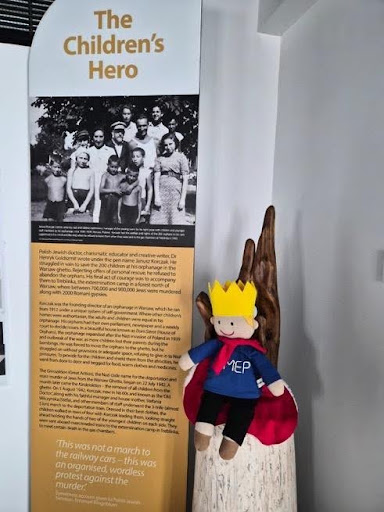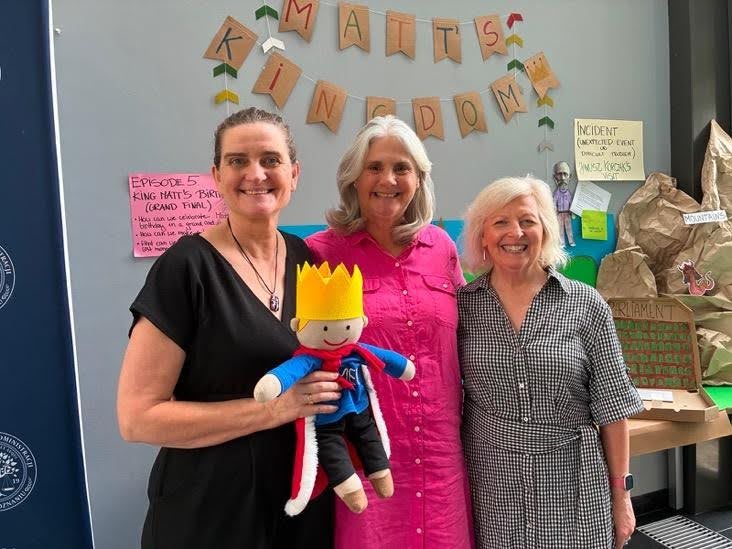
This July I travelled to Poznań in Poland for the 78th OMEP World Assembly, dedicated to the children’s rights pioneer, Janusz Korczak. My thanks to OMEP Australia, whose travel award made my journey possible. My paper, When a Child Feels, asked what kind of knower a young child is. Children are poets and philosophers, wrote Korczak, who sometimes find it hard to put their thoughts into sentences.
So, who was Korczak? He was born Henryk Goldszmit (1878/79 – 1942), a Polish-Jewish paediatrician, educator and writer. He was instrumental in democratic education and internationally famous for establishing Children’s Homes where children and adults governed together, with a parliament, newspaper and court. However, it is often overlooked that Korczak’s pedagogy began from the very youngest, as he studied and worked with babies, toddlers and the children at the Różyczka (Little Rose) Kindergarten. During World War II, Korczak refused offers of rescue, instead walking with defiance alongside his teachers and children deported to the Nazi death camp at Treblinka. I closed my OMEP workshop with his words: “the child foretells the spring”. Korczak believed that children sense what is coming before adults have words for it. That quote will now appear on the OMEP Australia plaque beside our tree in the Korczak forest at Treblinka – a sign of new life.
Korczak is often called the ‘father of children’s rights’ as he is the inspiration behind the proposal of the UN Convention on the Rights of the Child. Internationally, he is mentioned alongside other educational theorists, but he does something different. He does not hand us another framework from above. He shows us how children’s rights emerge from below, from what educators do every day: noticing, listening, slowing down, and having the courage to change their plan. His focus on everyday interactions is why his ideas can feel so familiar to our sector.
In my presentations, I often focus on Korczak’s concept of The Open Window. Many staff I meet feel boxed in by policies, ratios, and paperwork. He understood hands-on practice with children, and working in institutions during harder times than ours. His answer was never to wait for the walls to come down. There is always a window to open: a little sunshine, some fresh air, a view into the distance. When times are tough, we need Korczak more, not less.
Back home, the Australian Korczak Association now works in partnership with the Adelaide Holocaust Museum. Since returning in September, I have spoken with more than 500 early childhood leaders and educators across Australia and Singapore, and the enthusiasm for Korczak’s ideas is spreading.
So, we are building a Korczak community: a network of leaders and educators opening windows in their own settings, and learning from each other as they do. Come and join us. We would love to hear from you at [email protected].